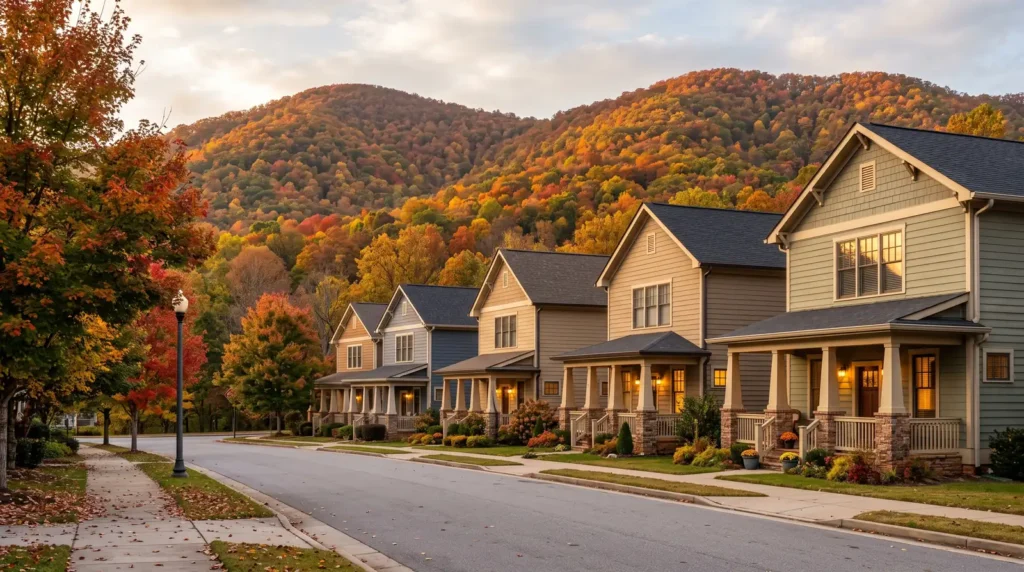
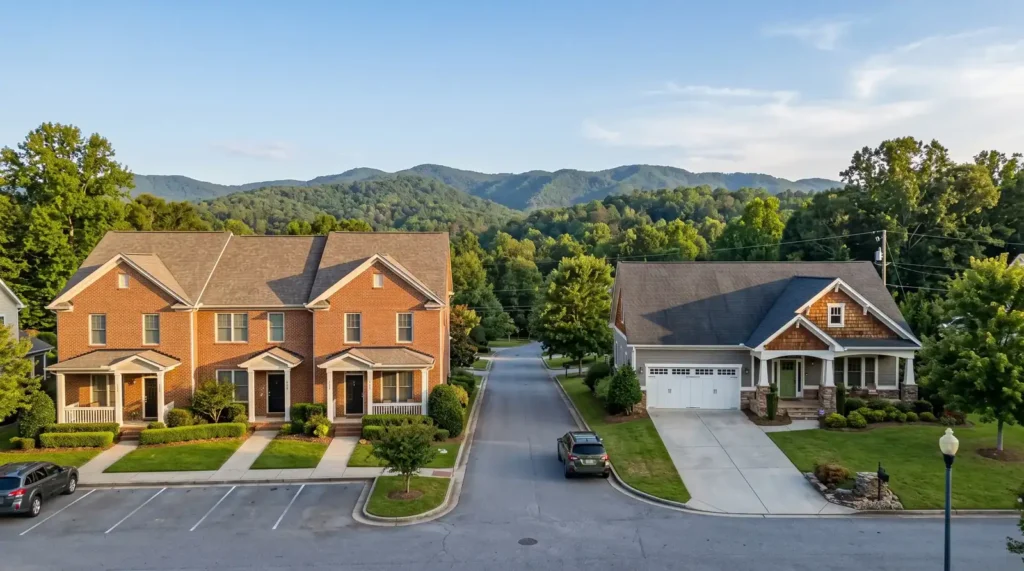
Townhouses in Dahlonega typically price below comparable single-family homes in the same area, but buyers also take on HOA fees that most single-family owners do not pay. The two property types sell in different price bands, serve different buyer profiles, and carry different ownership cost structures. A purchase-price comparison alone misses the point. Total cost of ownership and local inventory both shape the decision.
Dahlonega townhouses and single-family homes sell at different price points and carry different ownership costs. Buyers comparing the two need to account for HOA fees, maintenance structure, and current inventory alongside the purchase price before drawing a conclusion.
Buyers comparing a Dahlonega townhouse to a single-family home often anchor on the listing price and stop there. The issue with that approach is that HOA fees, maintenance responsibilities, and available inventory all affect what buyers actually pay and how quickly they can close. This page covers those differences from a market-data standpoint. For a closer look at how per-unit prices break down, see our guide to Dahlonega townhouse vs. house cost breakdown.
How purchase prices compare in the Dahlonega market
Townhouses in Dahlonega have consistently listed and closed at prices below single-family homes in the same area, but the margin between them varies by location, condition, and what the HOA covers. Buyers who filter on purchase price without accounting for the monthly fee difference end up comparing unequal total costs.
The per-square-foot picture is less predictable. Townhouses are typically smaller in recorded living area than detached homes at the same price point, which can push their cost per square foot equal to or above what a buyer would pay for a larger detached home nearby. Whether that trade-off works depends on which costs matter most: upfront price, monthly outlay, or total usable space.
| Factor | Dahlonega townhouse | Dahlonega single-family home |
|---|---|---|
| Typical price band | Lower end of the local market; verify current MLS for active comps | Broader range extending above townhouse comps; active inventory sets the ceiling |
| Per-square-foot basis | Often comparable to or higher than detached homes in the same price tier due to smaller recorded area | Lower per-sqft in many cases because of larger recorded living area; verify with comparable closed sales |
| Price band width | Narrower: community structure limits the spread between units in the same development | Wider: lot size, age, condition, and location drive larger price gaps between properties |
| HOA fee | Ongoing monthly cost not reflected in the sale price | Typically no HOA, or a lower monthly fee than a townhouse community |
A townhouse price from six months ago set against a single-family price from last month does not produce a clean comparison. Dahlonega’s market moves. When building a comparison, confirm that both property types come from the same recent closing-date window and the same area, measured with the same square-footage source.
What the per-square-foot numbers actually show
Per-square-foot analysis is a useful screening tool but does not settle the property-type comparison on its own. Townhouses often have smaller recorded areas than single-family homes at the same price, which can push their per-square-foot figure higher even when the total purchase price is lower. For a detailed walk-through of the purchase math, see our guide on how much it costs to buy a townhouse in Dahlonega.
When comparing the two property types on this basis, confirm that you are using a consistent measurement source. MLS recorded area, tax records, and builder plans do not always agree. A small square-footage discrepancy can meaningfully change the ratio when properties are already close in price.
HOA fees and maintenance: the ownership cost that does not appear in the sale price
HOA fees are among the most significant cost differences between Dahlonega townhouses and single-family homes. Most Dahlonega townhouse communities carry monthly fees covering exterior maintenance, landscaping, and sometimes shared amenity costs. Most detached single-family homes in the area carry no HOA or a modest one. That monthly difference needs to be part of any honest cost comparison.
What HOA fees cover differs by community. Some cover basic exterior work and landscaping. Others include roof maintenance, structure insurance, or shared amenity access. Before comparing monthly carrying costs, get the current fee amount, the reserve fund balance, and the board meeting minutes. A low fee backed by a thin reserve is not the same as a higher fee with an adequately funded reserve.
Listing pages often show a monthly HOA amount but not the reserve study, the current budget, or pending assessments. A pending special assessment or thin reserve fund adds ownership risk that the listed fee alone does not capture. Request the full HOA financials and board minutes before treating any fee figure as complete information.
A Dahlonega townhouse’s monthly carrying cost (mortgage plus HOA fee) is often higher than a single-family home at the same purchase price. But the townhouse typically includes exterior maintenance that a single-family homeowner pays separately. The more useful comparison is total annual cost of ownership, not just the fee line.
Market inventory: how many of each type are available in Dahlonega
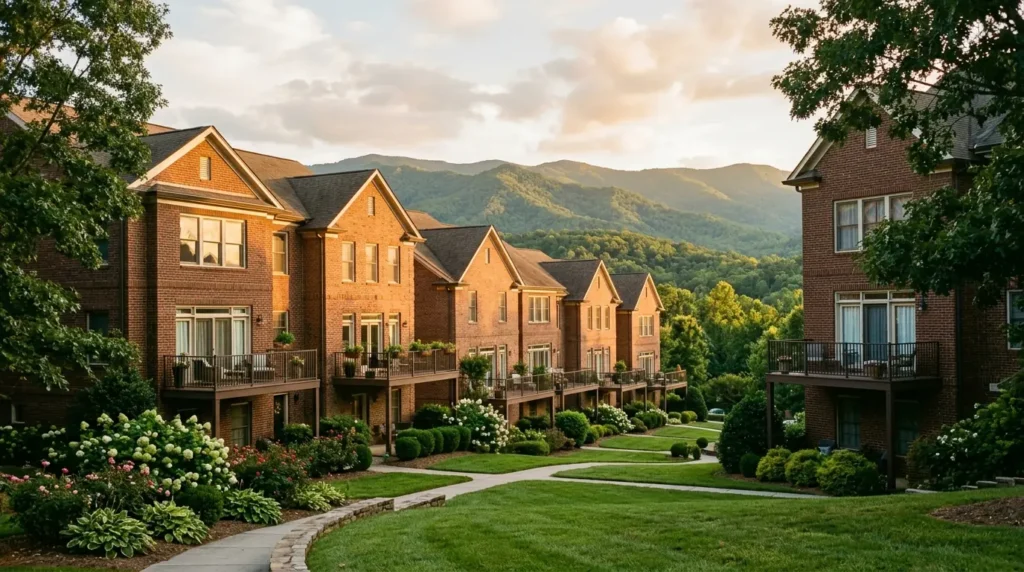
Single-family homes outnumber townhouses in the Dahlonega market at any given time by a wide margin. That inventory gap affects buyer negotiating position, days on market, and how quickly a purchase can close. A buyer who needs to close in 30 days has fewer townhouse options than one with a longer timeline.
New-construction activity shifts this balance periodically. When a townhouse development is actively building, the supply of available units can increase temporarily. Resale townhouses outside an active development face a more limited comp pool, which can compress pricing or extend days on market depending on demand. Buyers considering a townhouse should check both active and recently closed inventory to understand whether they are looking at a period of higher-than-typical supply or a thinner market.
For buyers tracking rent-to-own trade-offs, our rent vs. buy analysis for Dahlonega townhouses covers how inventory conditions affect the break-even calculation.
Resale and buyer demand for each property type
Resale trends for Dahlonega townhouses have broadly tracked the North Georgia market, but townhouse resale values sit in a narrower price band than detached homes. A community’s physical condition, HOA financial health, and proximity to the University of North Georgia campus or downtown all affect townhouse resale more than they would for a detached home on a comparable lot.
Single-family homes have more individual variation in resale outcomes. A lot upgrade, major renovation, or unique location can push a detached home well above what nearby townhouse comps show. That upside is not typically available to townhouse owners, who benefit from stable community-level pricing but do not capture as much appreciation from individual improvements. For more on townhouse-specific resale patterns, see our guide to Dahlonega townhouse resale value.
Both property types have broadly tracked North Georgia market trends, but townhouse resale outcomes are shaped more by HOA health and community condition than detached home outcomes are. Single-family homes offer more individual upside from improvements; townhouses trade that upside for narrower price compression across comparable units in the same development.
- Build both comp sets separatelyPull recent closed townhouse sales and single-family sales in the same Dahlonega area from the MLS. Keep the two property types in separate groups. Combining them distorts both sets.
- Add the HOA cost to each townhouse compList the current monthly HOA fee alongside the purchase price for each townhouse comp. A low-fee townhouse is not directly comparable to a high-fee one at the same purchase price.
- Estimate annual ownership cost, not just the mortgageFor each property type, estimate the annual mortgage payment, HOA fees, insurance, taxes, and expected maintenance. The comparison often shifts when all cost lines are included.
- Check the HOA reserve fund statusA townhouse with a thin reserve fund carries risk that the purchase price does not show. Request the reserve study and the most recent budget before making an offer on any Dahlonega townhouse.
- Review market availabilityPull current MLS data for both property types, including active listings and recent closings. A thin pool in either category affects negotiating position and time to close.
Which buyers each property type typically attracts
Townhouse buyers in Dahlonega tend to share a profile: less exterior maintenance responsibility, a lower entry price, or a specific community structure, with the HOA accepted as part of that trade-off. Many are second-home buyers, university-adjacent purchasers, or buyers wanting a lower-maintenance position in the North Georgia market without the full maintenance load of a detached home.
Buyers weighing townhouses against single-family homes in North Georgia often prioritize lot control, fewer HOA use restrictions, and the ability to make improvements that add individual resale value. Buyers planning to stay long-term, make significant updates, or who need the flexibility a detached lot provides tend to find more of that in the single-family inventory.
Neither property type is universally better. The comparison depends on buyer priorities, budget, and timeline. The useful frame is not which type costs less to buy, but which type’s total cost structure and market behavior fits what the buyer actually needs.
Frequently Asked Questions
Are Dahlonega townhouses cheaper than single-family homes?
On purchase price alone, Dahlonega townhouses typically list and close below single-family homes in the same area. But townhouses carry monthly HOA fees that most single-family buyers do not pay, which narrows the gap in annual ownership cost. The total cost comparison depends on the specific fee, what it covers, and how long the buyer plans to hold the property.
What does a Dahlonega townhouse HOA fee typically cover?
Coverage varies by community. Common inclusions are exterior maintenance, landscaping, and shared-area upkeep. Some communities include roof responsibility, structure insurance, or amenity access. Others cover only basics. Review the full HOA budget and reserve study rather than relying on the listed monthly amount alone.
Do single-family homes in Dahlonega have HOA fees?
Some do and some do not. Many older Dahlonega neighborhoods have no HOA. Some newer planned communities carry HOA fees, though typically at lower monthly amounts than townhouse communities. Confirm the HOA status for any specific property before comparing monthly costs.
Which is easier to buy right now, a Dahlonega townhouse or a single-family home?
Single-family homes significantly outnumber townhouses in the Dahlonega market, so buyers generally have more options in the detached category at any given time. Townhouse inventory can be limited depending on the season and whether new construction is active. If having choices and a shorter timeline matter, the single-family inventory typically provides more flexibility.
How does the per-square-foot price compare between the two property types in Dahlonega?
The per-square-foot comparison is less predictable than the total purchase price comparison. Townhouses are often smaller in recorded area than single-family homes at the same price, which can push their per-square-foot figure equal to or above nearby detached homes. Verify using a clean comp set with the same square-footage measurement source for every property included.
Which property type holds its value better in Dahlonega?
Both types have broadly tracked the North Georgia market, but the resale comparison differs in character. Single-family homes offer more individual upside from lot improvements and condition upgrades. Townhouses sell in a narrower price band tied to community-level conditions and HOA health. Neither type consistently outperforms the other across all time periods.
Can I make improvements to a Dahlonega townhouse to increase resale value?
Interior improvements can help marketability. The HOA governs exterior changes, and most townhouse communities restrict what owners can alter on the exterior, roof, or shared structural elements. Review the CC&Rs before planning any improvement beyond the unit interior. Interior renovations can improve appeal, but the upside is typically smaller than for a detached home where the owner controls the full structure.
Is financing harder for a townhouse than a single-family home in Dahlonega?
It can be, depending on the lender and the specific community. Some loan programs treat attached dwellings differently and may require HOA documentation, a minimum owner-occupancy ratio, or proof that the HOA is financially sound. Buyers planning conventional financing should confirm that the community is warrantable before making an offer.
How do property taxes compare for Dahlonega townhouses vs. single-family homes?
Property tax is calculated on assessed value, which depends on the appraised value of the specific property. A townhouse priced below a single-family home in the same area generally carries a lower assessed value and a lower tax bill. Confirm with the Lumpkin County Tax Assessor for the specific parcel. Taxable value and HOA financial status are separate considerations.
What HOA documents should I review before buying a Dahlonega townhouse?
Start with the current monthly fee and what it covers. Then check the reserve fund balance relative to the reserve study’s funding target, the most recent board meeting minutes for any pending assessments or disputes, the master insurance policy to confirm coverage scope, and the CC&Rs for any use restrictions relevant to how you plan to use the property.
Do Dahlonega townhouse communities allow short-term rentals?
Each community handles this differently. Review the CC&Rs and board minutes for the specific community before assuming any rental arrangement is permitted. Some communities prohibit short-term rentals; others restrict minimum rental periods. Confirm with the HOA directly before purchasing for that purpose.
Which is better for a first-time buyer, a Dahlonega townhouse or a single-family home?
First-time buyers are often drawn to townhouses for the lower entry price, but the monthly HOA fee adds a fixed cost that does not appear in the listing price. A first-time buyer comparing both types should model the full monthly cost, including HOA fee, estimated insurance, taxes, and a maintenance reserve, rather than the mortgage payment alone before deciding.
Looking for Dahlonega townhouse and single-family options?
Connect with a local agent who tracks both property types across the Dahlonega market.
Request a custom Dahlonega, North Georgia home search from Gold Peach Realty or call (770) 283-1223.